
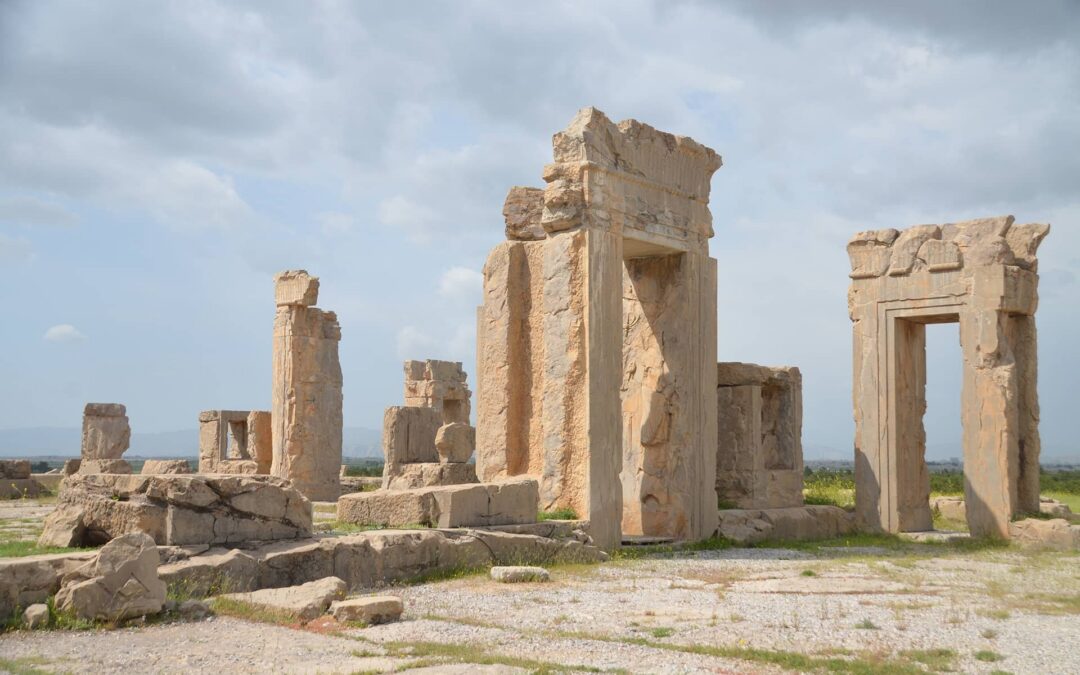
In 330 BCE, the historical Alexander set fire to Persepolis, shortly after accepting the city’s surrender. By the time the flames went out, the ceremonial heart of the Achaemenid Persian Empire, which had taken a hundred years to build, was little more than a field of scorched stone.
In The Golden Vine, Alexander doesn’t die young, and Persepolis doesn’t burn. It becomes something else entirely: the capital of an empire spanning the known world, and beyond. Before a single panel of this imagined city could be drawn, author Jai Sen had to answer a harder question than “what did Persepolis look like?” It was, “what could Persepolis have become?”
Why did Alexander burn it?
Remembered as the most magnificent of the four capitals of the enormous Persian Empire, Persepolis was a center of trade and imperial administration until Alexander ordered his soldiers to loot it and burned its royal palace to the ground.
The exact circumstances are not definitively known. The most widely repeated account holds that an Athenian courtesan urged Alexander to commit the destruction in the name of revenge, because an earlier Persian king had dared to invade Greece generations before. Whatever his reasons, the burning of Persepolis gives us a stark portrait of the historical Alexander’s instability and his legendary temper. At his best, he preserved and united. At his worst, he destroyed irreplaceable treasures impulsively and without pity or mercy.
The entirety of The Golden Vine hinges upon Alexander’s actions upon his arrival at Persepolis. That is the moment history is altered in The Golden Vine, and from there Alexander begins to proceed along a different path than his historical counterpart. In the book’s narrative, Persepolis becomes the center of Alexander’s world empire, a city of such importance as to exceed even the dreams of the Persian kings who set its foundations.
But what was this place, who built it, and how was it brought back to life for The Golden Vine?
What was actually there
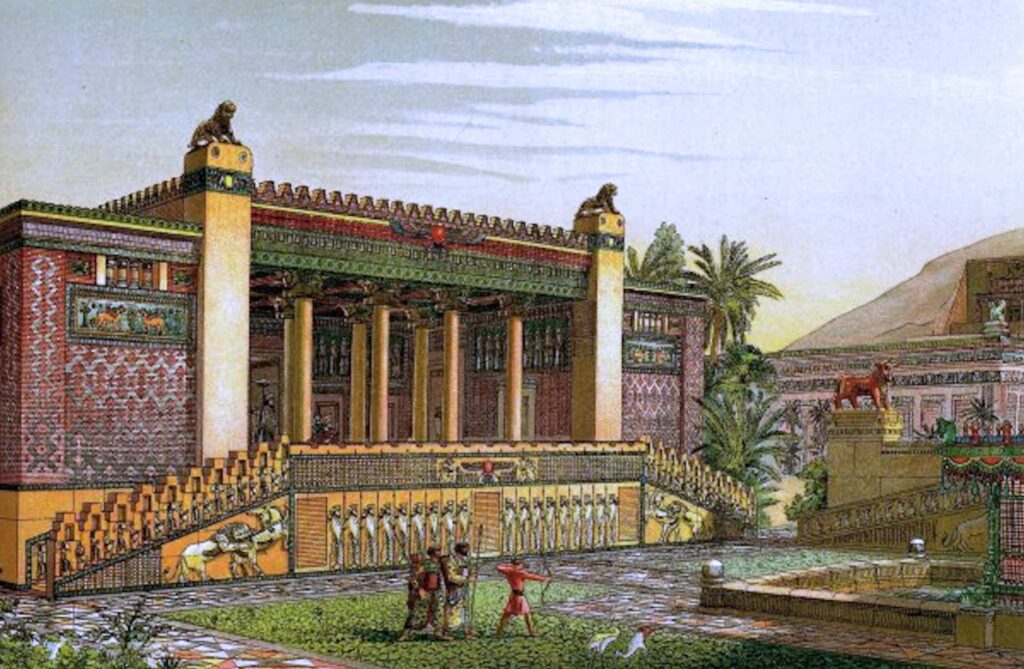
Persepolis was founded around 518 BCE by the Persian ruler Darius the Great, on a stone terrace at the foot of a mountain the Persians called the Mountain of Mercy. Each subsequent Persian king continued adding to the palace complex, and the whole took more than a century to complete. By Alexander’s time the city had been thriving for generations as the ceremonial capital of the empire, the place where the Persian kings celebrated the all-important new year ceremony by receiving tribute from the subjects of their vast lands. Even when Alexander arrived, there were signs of fresh construction. The palace complex at Persepolis is thought of as the pinnacle of Persian art and architecture.
At its center stood the Apadana, a magnificent audience hall: 72 columns, each nearly 80 feet tall, supporting a roof covering 10,000 square feet of floor. Its stairways were carved with processions of tribute-bearers from every corner of the empire: Lydians, Bactrians, Ethiopians, Scythians, and many more, each rendered in careful, individual detail, all converging on the throne of the King of Kings, the shahenshah.
None of this survived Alexander’s arson. What we know of it comes almost entirely from archaeology, and relatively recent archaeology at that. The site was buried and half-forgotten for centuries before the German-led Oriental Institute expeditions of the 1930s, under Ernst Herzfeld and later Erich Schmidt, began the long work of excavating, mapping, and in places rebuilding it stone by stone. In a real sense, the Persepolis we can visualize today—the one in textbooks and museum reconstructions—is itself already a kind of imaginative act, built by archaeologists filling gaps in the record with careful, informed guesswork.
That gave Sen permission to do the same thing, one step further.
Rebuilding the dead city, in 2003
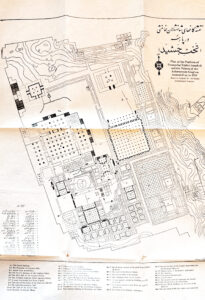
It is worth remembering how little was available when Sen was researching The Golden Vine in the early 2000s. There was virtually nothing online: no immersive reconstructions, no searchable photographic archives, no 3D models to consult. Rebuilding Persepolis meant physically assembling a library and, ultimately, building scale models for the artists’ reference.
Since Persepolis figures as a primary location for one of the narratives in The Golden Vine, the creative team delved into every source it could find, including booklets and maps procured from the Iran Society. Taking examples of Persian art and architecture from surviving cities, dry but informative administrative documents found in the ruins, and the notes of several archaeological digs, Sen meticulously reconstructed the city and palace piece by piece.
Once Persepolis was restored to its former glory on the page, it could be pushed forward into an alternate future in which it had been established as the capital of Alexander’s world empire. Sen situated a magnificent lake at the center of the city, expanded the palace, and conceived a vast marketplace in the city’s northeast quadrant. He placed his fictional Alexander’s most controversial project, the Temple of All Faiths, high on the slopes of the Mountain of Mercy behind the royal palace, a sacred destination for pilgrims from all over the world.
The most difficult challenge of the whole reconstruction was the Persian king’s royal bedchamber, the original site of the legendary golden vine sculpture, and the exact point of Alexander’s departure from history in The Golden Vine. There was no surviving room to work from, only a general map of the general area. Sen had to build it entirely out of inference and imagination.
Building a Persepolis that never burned
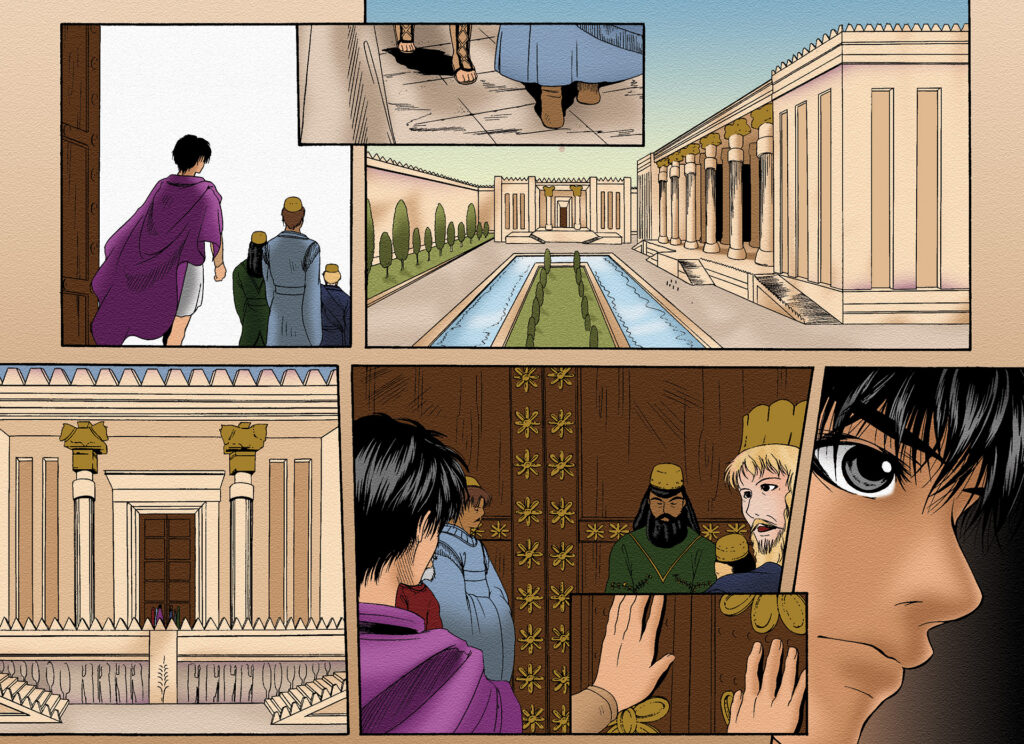
The first task was simple by comparison: to picture the Apadana and palace complex whole. Not a ruin, not a reconstruction drawing with dotted lines where the evidence runs out, but the central hub of a working palace. Sen imagined torchlight on gilded column capitals, envoys waiting on the stairs, the scale of a place actually felt rather than described. Though artist Seijuro Mizu was the trained draftsman, a skill visible in his careful reconstruction of the wondrous cities Hephaestion describes, animator Umeka Asayuki was the artist tasked with drawing Persepolis. She chose to illustrate it as the monument to imperial glory that it had been. She used vertical exaggeration to show the dizzying height of the columns, and the angles of sunlight showed the specific way light would have moved through a room that size at different times of day. It is in the Apadana that we see the body of an aged Alexander, draped in a cloak of royal purple, ceremonially displayed in a magnificent golden boat filled with poppies and white orchids. In this gigantic chamber, we realize this is the first time in years—perhaps decades—that Alexander IV has seen his father. Courtiers receiving the prince reveal that Persepolis is the city of the prince’s birth. We learn that he may not have even visited it since his infancy.
The harder task was the second one: this wouldn’t be Darius’s Persepolis anymore. It’s Alexander’s, the capital of a world empire that, in our version of history, eventually reaches past India, past China, to shores nobody in the ancient Achaemenid court had ever heard of. So what happens to the palace and its surrounding city?
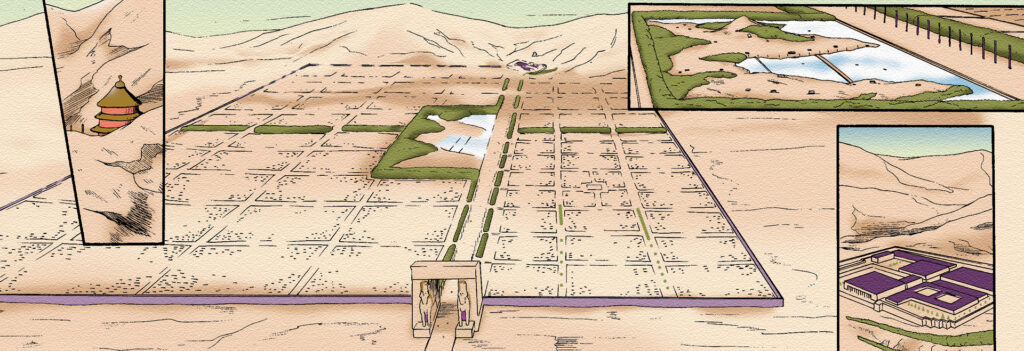
Sen decided the answer was to ensure that it would keep growing the way it always had. Adopting same visual grammar the Achaemenids themselves used, he reverently retained Persepolis as the location of Alexander’s change of heart, building it into a wonder beyond what Alexander’s predecessors got the chance to create. Readers of The Golden Vine will recognize this as one of Sen’s guiding rules for the whole book: to change the outcome, not the logic. The empire in The Golden Vine behaves the way a real empire would, expanded on its own terms. Alexander, we learn, decreed a less ostentatious era, damping the indescribable opulence of Persian royal and imperial customs and palaces except in a very few permitted cases. And yet Persepolis dazzles in its sheer scale and importance. The palace, especially its gardens, create an oasis within what is obviously a bustling city in a prosperous and well-governed world. Or so it appears.
What was modified, and what wasn’t
Sen kept some things deliberately faithful. Most of the ground plan of the palace stayed the same: the terrace, the placement of the Gate of All Nations, and the general proportions of the Apadana are all pulled directly from models that were made from excavation plans. Getting the bones right made it easier to convincingly build on top of them. Sen changed other things outright for the story. Certain interior chambers and gardens exist in the book that have no archaeological basis at all, so the reader can presume that the palace saw some expansion between when Alexander first arrived and the time of his death.
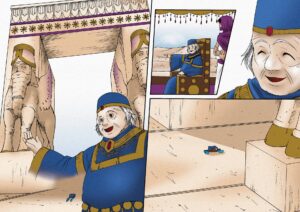
As the courtier Faramarz’s tour of the city shows, most reflections of Alexander’s imperial expansion are visible in the city surrounding the ceremonial heart of Persepolis. We see a massively rebuilt (and symbolically much more significant) second Gate of All Nations at the city entrance; a central market sprawling over square miles; and the Temple of All Faiths rising magnificently, a red edifice placed high on the slopes of the Mountain of Mercy. All these imagined features will figure prominently into the story that begins to unfold in The Golden Vine.
Seeing it come to life
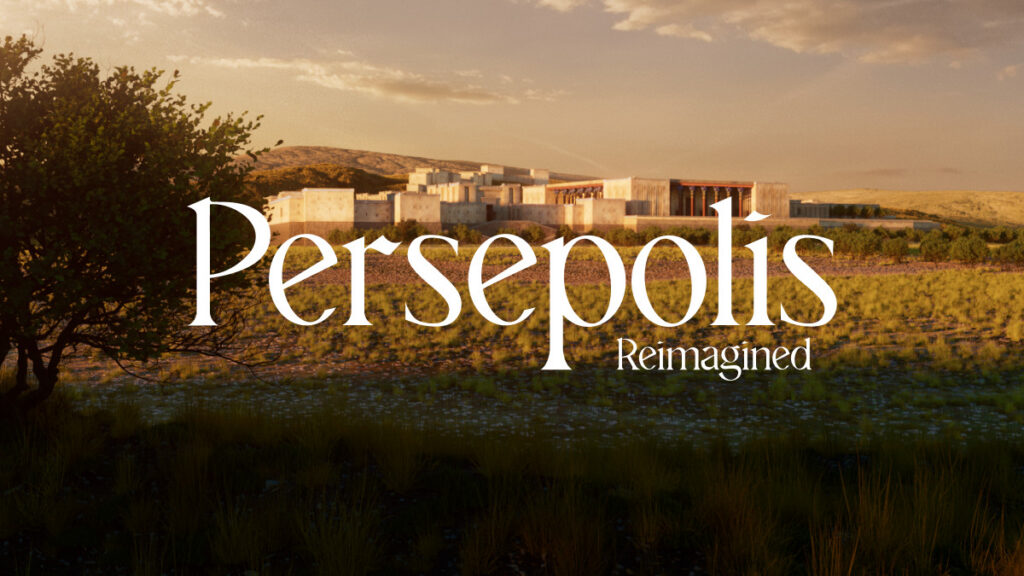
For Sen, one of the strangest parts of returning to this material is how much the world has changed around it. What took months of correspondence and physical books to assemble in 2000 is now, in significant part, a click away. Museums have digitized their excavation archives. Scholarly reconstructions circulate freely. In 2022, two decades after Sen completed the story materials for The Golden Vine, Getty released Persepolis Reimagined, an immersive web experience that walks visitors through the ceremonial capital at its height, entering through the Gate of All Nations and its painted guardian bulls, past the Apadana and the Palace of Xerxes, ending at the Hall of 100 Columns. It was built by historians, technologists, and academic consultants working together, and it is the most accurate recreation of the site yet made.
“I spent months in 2003 building this place out of 5 year-old booklets, maps, and other people’s footnotes, and then years living inside it in my imagination. To walk through it on a screen and recognize it, to know my way around, to see the light fall the way I had imagined it falling, was magical, and unexpectedly poignant. I wish I had this when I was working on the book, and relieved that it’s mostly small details I got wrong with what I had to work with back then. I am glad this recreation exists now, even though it arrived long after I needed it.”
—Jai Sen
Further reading
If you want to go further down this particular rabbit hole, a few starting points:
- Persepolis Reimagined (Getty) — a 3D walkthrough of the site’s key locations, and the single best way to get a feel for the place as it stood
- Smarthistory’s overview of the Apadana is a clear, well-illustrated introduction to the hall itself
- The Oriental Institute (now ISAC) at the University of Chicago maintains extensive archives from the original 1930s excavations, including photographs and site plans
- Forgotten Empire: The World of Ancient Persia, edited by John Curtis and Nigel Tallis, remains one of the best single-volume visual references on Achaemenid art and architecture
- The Met’s essay on Ernst Herzfeld covers the excavation history in more detail, for anyone curious how much of “what Persepolis looked like” is itself a twentieth-century reconstruction