
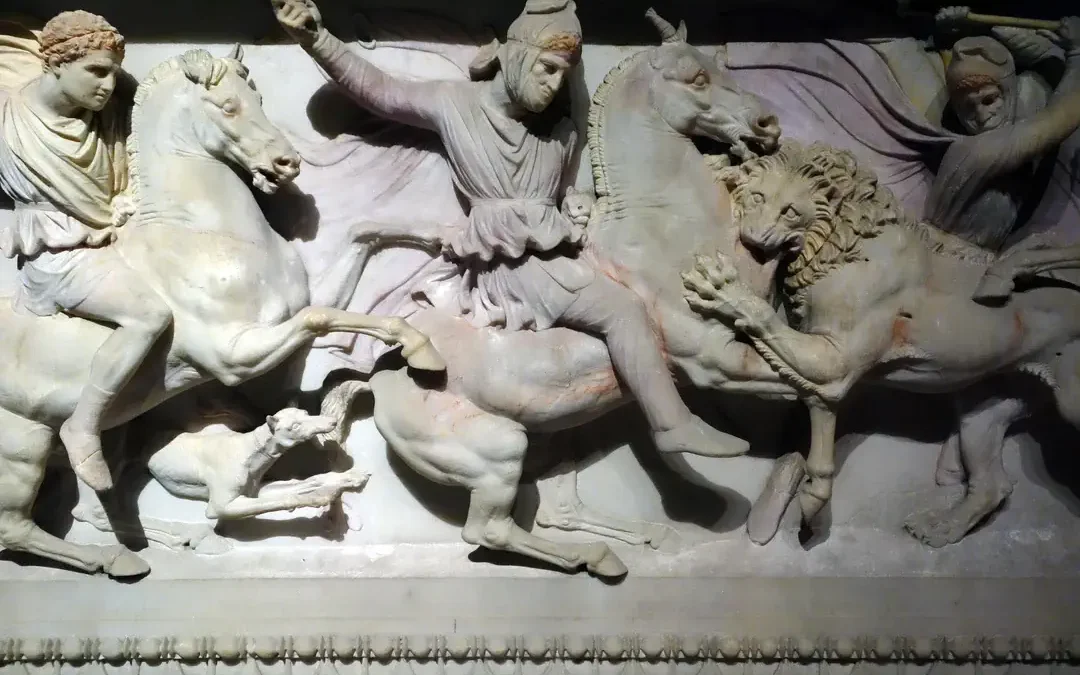
The figure on horseback at left is thought to be Hephaestion. From the Alexander Sarcophagus in the Istanbul Archaeology Museum. Image: Wikimedia Commons.
Who was Hephaestion?
Scholars are divided on the subject. On one hand, he was clearly someone very important to Alexander (one of his titles is "Hephaestion Philalexandros," or "Alexander's Friend"), a close confidant, and carried major responsibilities in Alexander's campaigns.
On the other hand, practically no information about him exists, and scholars tend to dismiss him as a hanger-on, someone who took advantage of Alexander's fierce loyalty to advance his own career, or (in the fashion of the times) someone that Alexander was merely romantically involved with.
Whichever of these was really the case, he was present at most of the important events of Alexander's life, and Alexander's trust in him was never broken. Hephaestion was the only unwavering supporter of Alexander's plan to merge Greek and Persian culture, and also enforced many other unpopular decisions without question. It is possible that rivals for Alexander's favor destroyed records of Hephaestion's life and accomplishments after both he and Alexander were dead. Another possibility is that Alexander himself erased traces of his friend's mortal existence: after Hephaestion's untimely death, Alexander appealed to the Greek priesthood and tried to have his companion elevated to the status of a god or divine hero.
Or could it be that Hephaestion's background was actually very humble, and was deliberately covered up to enable his meteoric rise and privileged status in Alexander's growing empire?
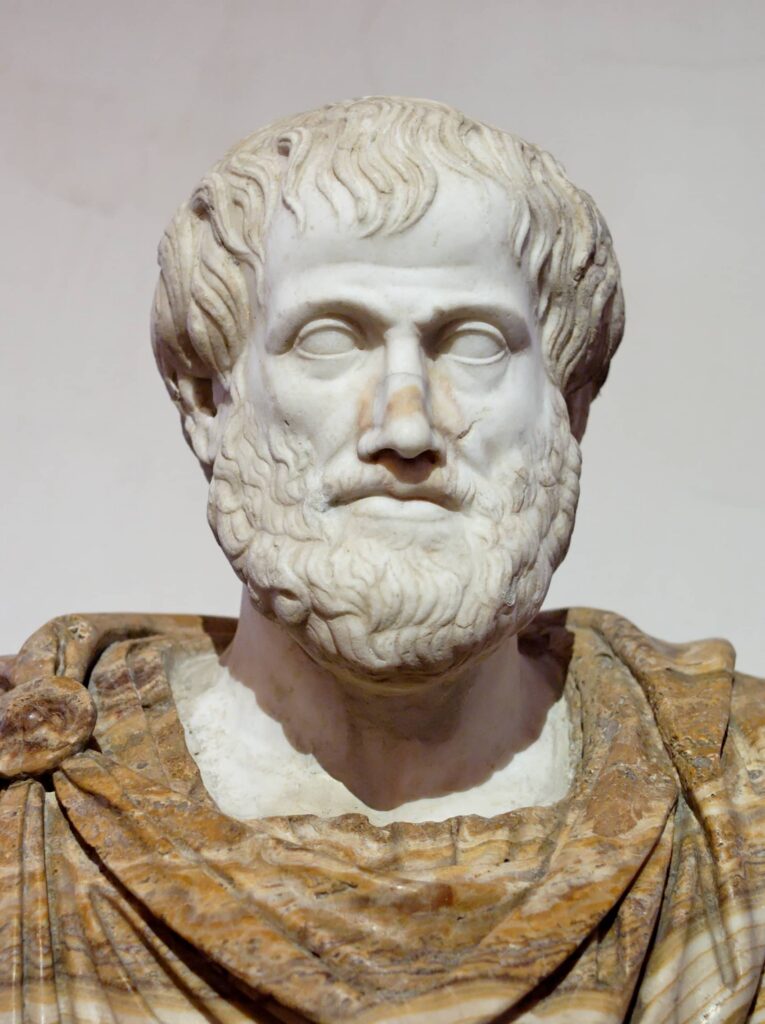
Image: Wikimedia Commons.
His origins
It is known that Hephaestion and Alexander had been friends since boyhood, and that they attended school together under the famous philosopher Aristotle (in fact, Hephaestion and Aristotle maintained a correspondence even when Hephaestion was away in distant lands). This means that Hephaestion's father would have to have been someone of rank (though not necessarily born into that status) in the court of King Philip, Alexander's father.
Therein lies the mystery. Other than some references to a grandfather, nothing else about Hephaestion's family other than his father's name and position is known. There is no record of Hephaestion's mother, and the family's last name, "Amyntoros," is a typical Macedonian surname of the time, but is spelled in the Greek style (the Macedonian version would have been "Amyntas"). "Hephaestion" (or "Hephaistion") is also not at all a common Macedonian name; in fact, it is typically Athenian. The name references the cult of Hephaestus, the god of the forge, a deity popular in Athens but not broadly worshipped in Macedon.
Could it be that Hephaestion's family had ties to Athens, or that Hephaestion may have been born there and not in Macedon?
What did Hephaestion look like?
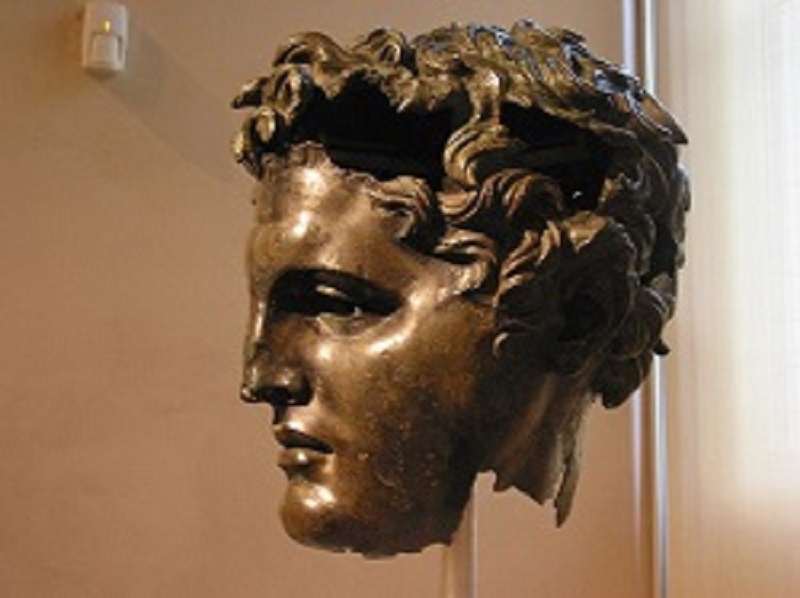
Image: Wikimedia Commons.
As with so many other aspects of his life, information about Hephaestion's appearance is strangely lacking. Sculptures and portraits that are thought to represent him don't look all that much like each other, and bear strong traces of being stylized in the aesthetic of the times. It is generally agreed that he was tall and strikingly handsome.
One interesting anecdote survives. After overthrowing Darius III, the Great King of Persia, Alexander went into the Persian royal tent (accompanied as usual by Hephaestion) to inspect the captured property. To his surprise, he found that Darius had left behind his mother, wife, and son when he fled.
The Persian royal family, thinking that the Macedonians had come to kill them, feared for their lives. Darius' mother, Sisigambis, assuming that the taller and more handsome of the two men was Alexander, rushed forward and threw herself at Hephaestion's feet.
Apparently she was mortified when it became clear that the beautiful man she was appealing to wasn't the scourge of the Persian Empire. Alexander, interestingly, received all this with amusement, and made a cryptic (yet somehow telling) remark: "Mother, it's all right, because he is Alexander, too."
Parts of this account made their way into The Golden Vine. It's also known that both Alexander and Hephaestion maintained a relationship with Sisigambis, who was treated with great dignity. It is believed that she rejected her son Darius for his cowardice and treated Alexander as her son in his place.
Were Alexander and Hephaestion lovers?
Intense debate continues on the subject of Alexander's sexuality. The issue is confused by the fact that the ancient Greeks had a complex set of mores on the subject, ones very different from the attitudes of our time.
Most Alexander scholars agree, however, some reluctantly, that Alexander and Hephaestion, like most boys their age in the society they lived in, were lovers, and that their closeness and intimacy continued for most (if not all) of their remaining lives.
With Hephaestion he remained in love, at a depth where the physical becomes almost irrelevant; and years later Bagoas [a Persian courtier] was still his recognized eromenos ["lover"].
—Mary Renault, The Nature of Alexander
At the age of thirty Alexander was still Hephaestion's lover although most young Greeks would have grown out of the fashion by then and an older man would have given up or turned to a younger attraction. Their affair was a strong one; Hephaestion grew to lead Alexander's cavalry most ably and to become Vizier before dying a divine hero, worthy of posthumous worship.
—Robin Lane Fox, The Search for Alexander
A more immediate project was the marriage of Alexander and Hephaestion, his closest friend and lover, to two of the daughters of Darius [the recently conquered Persian emperor], while another 80 Macedonian officers married daughters of Persian nobles.
—The Random House Encyclopedia, New Revised Edition
[Alexander's royal bodyguard] were the nobles whom Alexander loved and trusted, whether tough like Leonnatus, famed for his gymnastics, or shrewd like Ptolemy, a friend from childhood; Hephaestion still predominated, faithfully inclining to the Persian customs of his king and lover.
—Robin Lane Fox, The Search for Alexander
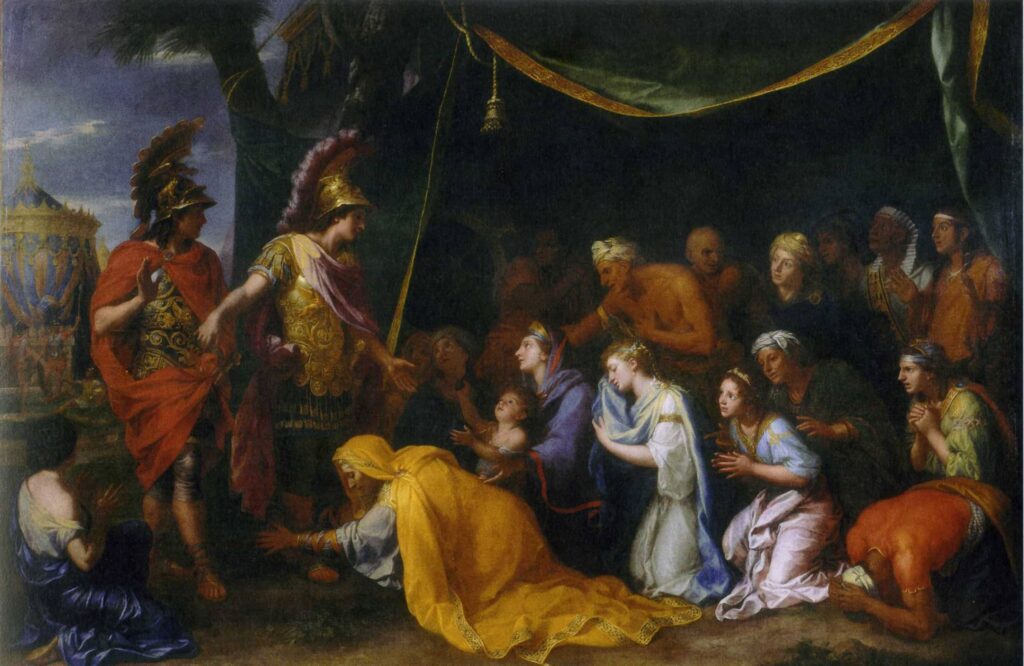
Image: Wikimedia Commons
Hephaestion in The Golden Vine
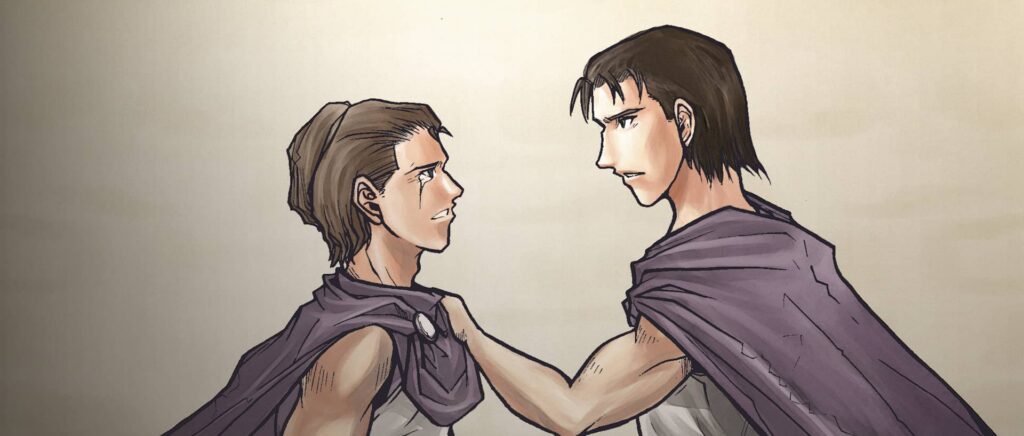
Hephaestion's mysterious background, Athenian name, and undying loyalty to Alexander add up to a wonderful opportunity to give him a history. In The Golden Vine's carefully drawn psychological portrait of Alexander, he also proved an outstanding witness to the conquerer's character and insights over the course of his life. In The Golden Vine, Hephaestion's grandfather, a Macedonian mercenary, is granted honorary Athenian citizenship for his military service. With only poverty and hardship awaiting him in Macedon, he accepts the offer and emigrates to Athens.
But he is disappointed when he gets there and finds that the residents of the famous Greek democracy look down upon his humble origins and provincial accent. Too ashamed to go back to Macedon, he stays in Athens--as a servant.
For three generations, Hephaestion's family stays trapped in a life of servitude in Athens, winding up in the household of a famous orator and politician named Demosthenes. While working there, Hephaestion's father is approached by a Macedonian spy...
To reveal more would spoil the story. Suffice it to say that Hephaestion and his father emigrate to Macedon, and Hephaestion and Alexander meet. A major portion of the story of The Golden Vine is told in Hephaestion's words, as he retells the remarkable chain of events he has witnessed.